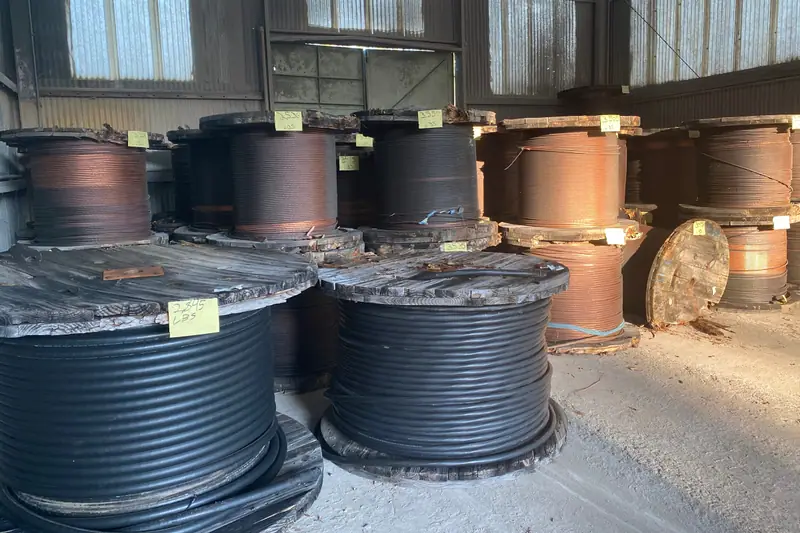
How to measure wire left on a reel: choose your method
Use the strongest information you can obtain without unspooling the cable unnecessarily. Readable sequential marks at both ends are usually more useful than estimating from reel fullness. Net weight is another practical option when you know the empty reel weight and the exact cable construction.
Geometry comes last because gaps, loose wraps, and uneven layers change the result. Label your number as measured, calculated by weight, or estimated by dimensions rather than presenting every result as exact. Our guide to partial reels and cut lengths explains the material you can submit for review.
- Record each reel separately, including cable type, size, conductor count, and identifying tag information.
- Keep heavy reels secured; do not tip or roll a reel just to expose an inaccessible cable end.
- Do not cut usable cable solely to obtain a footage reading.
Read sequential footage marks on the cable jacket
Some cable jackets carry sequential numbers that increase or decrease along the length. Confirm that these are length marks, not a manufacturing code, and check whether the units are feet or meters. Photograph several adjacent marks to establish their direction and spacing.
If both ends of one continuous cable are accessible, subtract the smaller reading from the larger reading. For example, end readings of 012450 FT and 012975 FT indicate approximately 525 feet between those marks. Account separately for unmarked tails beyond the readings.
One visible end reading does not establish remaining footage by itself. A starting number may not be zero, and the original reel tag may describe footage that has since been removed. Use our reel-tag reading guide to separate original quantity from current evidence.
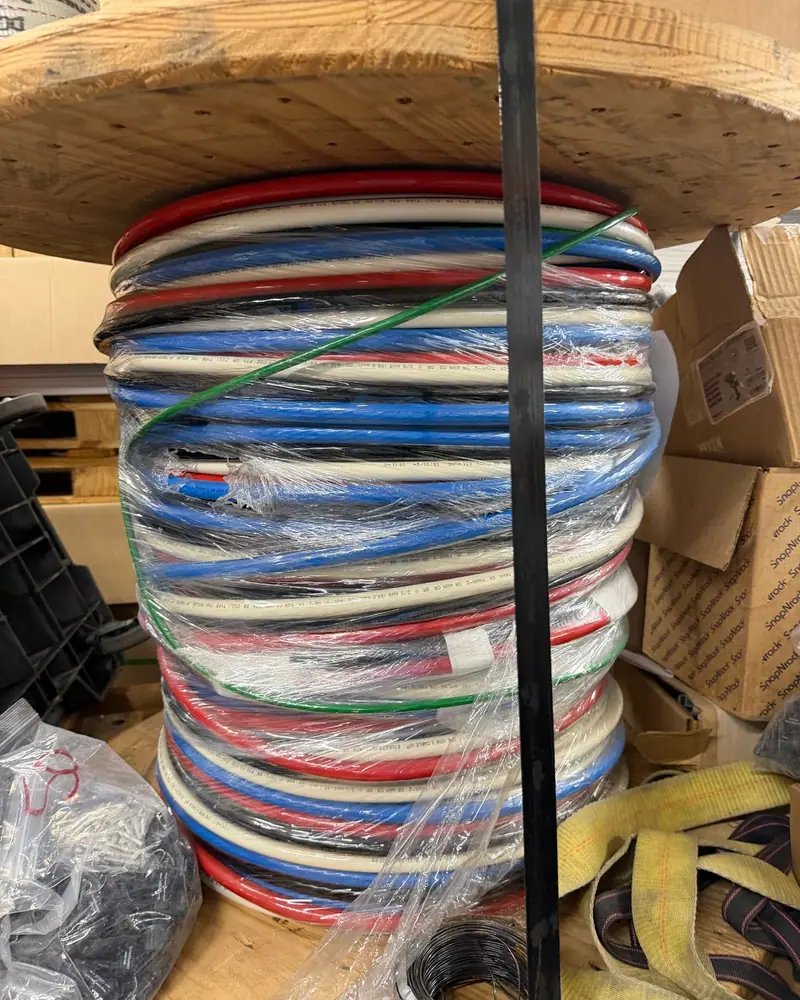
Calculate remaining footage from weight minus tare
Tare is the empty reel weight. Subtract tare and any separately known packaging weight from the scale reading to obtain net cable weight. Then use the manufacturer's weight per 1,000 feet for that exact cable, including its insulation, jacket, shielding, or armor.
The formula is: footage = net cable weight in pounds × 1,000 ÷ cable weight in pounds per 1,000 feet. As a hypothetical example, a loaded reel weighing 420 pounds with an 80-pound tare contains 340 pounds of cable. If that exact cable weighs 500 pounds per 1,000 feet, the calculated length is 680 feet.
Do not substitute bare copper weight or a different cable's catalog weight. Matching AWG alone is insufficient: conductor count, insulation thickness, and construction matter. See wire reel sizes and weights for the measurements to collect before relying on this method.
- Confirm that a tag weight describes the empty reel, not the original loaded shipment.
- Wet wood, mud, attached hardware, and unknown packaging can distort the net weight.
- If tare is estimated rather than known, label the resulting footage as an estimate.
Have reel tags or a footage list? Send photos and we will review the lot.
Get an offerEstimate cable footage using drum and winding dimensions
A flange-and-drum calculation estimates the space occupied by cable. Measure the outside diameter of the wound cable, the bare drum diameter beneath it, and the width actually occupied by the winding. The flange is the outer side plate; its diameter is not the wound cable diameter unless the cable truly reaches that edge.
For round cable, use: estimated feet = k × W × (D² − d²) ÷ (12 × c²). Here W is occupied winding width, D is wound cable diameter, d is drum diameter, and c is the outside diameter of one complete cable, all in inches. The factor k represents the share of winding space occupied by cable rather than air gaps.
For a hypothetical reel with W = 24 inches, D = 30 inches, d = 18 inches, and c = 0.5 inch, assuming k = 0.80 gives about 3,686 feet. That packing factor is illustrative, not a verified value for your reel. Unknown packing makes this a rough estimate, especially with crossed wraps, uneven layers, or flattened cable.
Check what a wire reel footage calculator actually assumes
A wire reel footage calculator is only as dependable as its inputs. Check whether it asks for cable diameter or conductor diameter, inches or millimeters, and wound diameter or flange diameter. Using the metal conductor diameter instead of the complete cable diameter can greatly overstate footage.
Also check whether the calculator includes a packing allowance. A calculation using k = 1 assumes no empty space between round cables and overstates what can fit. Do not apply the round-cable formula unchanged to flat NM-B, irregular bundles, or several cables wound together.
When two methods disagree, review the inputs instead of averaging the answers. A mistaken tare, meter-based jacket marks, or an incorrect outside diameter may explain the difference. Preserve both calculations and tell us which assumptions remain uncertain.
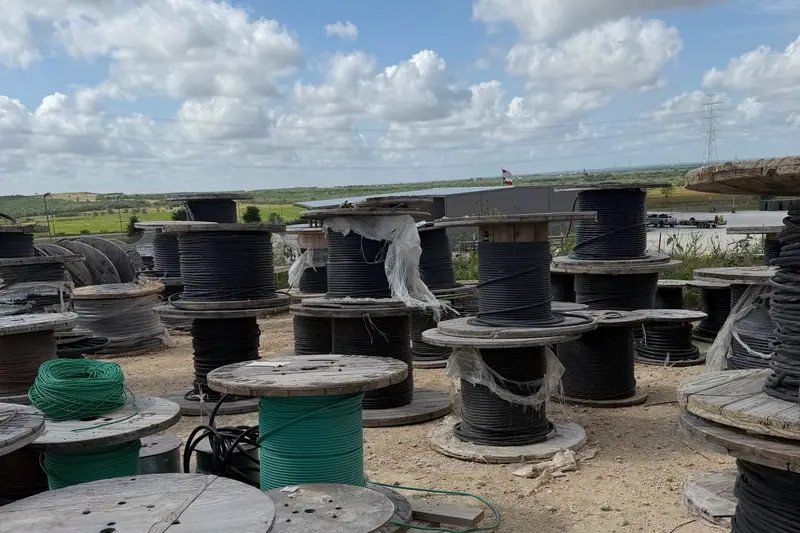
Document partial reels without overstating usable length
Footage and usable condition are separate questions. A reel may contain a substantial length but also have damaged jacket sections, exposed conductors, or multiple disconnected pieces. Record visible defects and identify whether your figure describes one continuous run or several lengths.
Photograph the whole reel, tag, jacket print legend, accessible cut ends, and any damage. Add scale readings or tape-measure readings when those support your calculation. Our wire photography guide explains which views help us evaluate the material.
For loose coils, identify each piece separately when practical. Do not combine several short pieces into one stated continuous length. If footage remains unknown, say so and provide the information you do have.
Use your footage estimate to describe reusable surplus
We buy new and unused full reels, partial reels, boxed coils, cut lengths, and project leftovers, along with used cable still in reusable condition. Cable type, ratings, packaging, condition, and continuous length help determine whether material can be resold for use.
Reusable wire is usually worth more sold as product than sold as scrap by weight because the buyer is paying for usable wire, not just metal. Our surplus wire value versus scrap guide explains that distinction. If your wire is not reusable, we say so honestly; it may belong with a scrap recycler instead.
Send your reel measurements for a written offer
Send photos and a list or footage estimate through our offer form, by calling 951-403-5738, or by emailing industrial832@gmail.com. Include the calculation method and any unknowns. We review the material and make a written offer before pickup, with payment method and timing confirmed in writing beforehand.
We verify the seller and proof of ownership, such as an invoice, purchase order, closeout paperwork, or company letter; see our Texas seller paperwork guide. We arrange pickup anywhere in Texas, or you can drop off by appointment at 6402 McGrew St, Houston, TX 77087; call first. At pickup or drop-off, we check the count against the written terms.