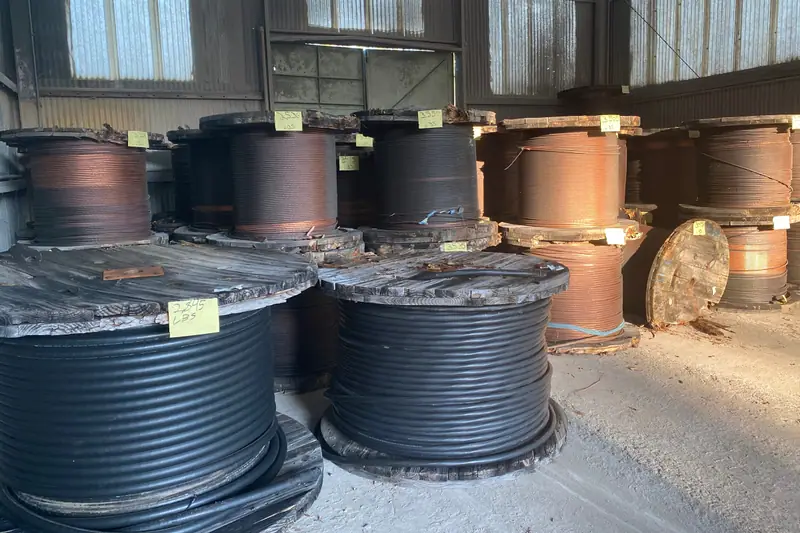
Wire Reel Sizes: Measure More Than the Flanges
Start with flange diameter: the distance across either circular end, measured through its center. Common nominal sizes include 12, 18, 24, 30, 36, 48, 60, 72, 84, and 96 inches, although manufacturers use other dimensions too. A nominal size is a useful description, not a complete freight specification.
Measure overall width across the outside faces of both flanges. If accessible without moving or disturbing the cable, record the drum diameter, inside winding width, and center arbor-hole diameter. These dimensions help distinguish a narrow reel from a wide reel with the same flange diameter.
Photograph the measuring tape in place and include a whole-reel view. Our wire reel selling guide explains what to submit when you have full reels, partial reels, or mixed surplus lots.
Empty Reel Tare Weights Are Only Roughly Related to Size
Tare weight means the empty reel, without cable. Small plastic or plywood spools may weigh only a few pounds, while substantial wooden reels can weigh hundreds of pounds; large heavy-duty wood or steel reels can exceed that. Construction matters enough that assigning one typical weight to each flange diameter can be misleading.
For an initial description, group reels by approximate diameter and construction rather than assigning an unverified tare. A 48-inch wooden reel and a 48-inch steel reel do not necessarily have similar weights, and reinforced export-style construction can differ substantially from lighter packaging.
Use a manufacturer’s reel specification, a clearly identified tare marking, or an actual empty-reel scale weight. Do not substitute a general estimate when selecting lifting equipment or booking freight.
- 12–24 inches: smaller packaging; identify plastic, plywood, wood, or steel construction.
- 30–48 inches: inspect flange thickness, drum construction, and any reinforcing hardware.
- 60–96 inches: obtain documented tare and loaded weight rather than estimating from appearance.
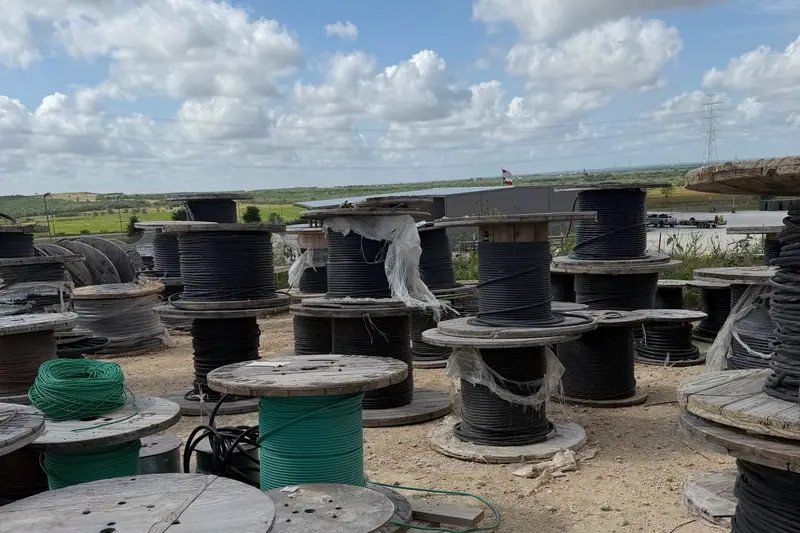
How to Build a Useful Cable Reel Weight Chart
A useful cable reel weight chart is a lot-specific inventory, not a universal diameter-to-weight lookup. Give each reel an ID and record its dimensions, cable description, estimated remaining footage, tare if known, and gross weight if measured. Mark every unknown or estimated entry clearly.
Gross weight is cable plus reel and any packaging on the scale. Net cable weight excludes the reel; a tag showing cable weight is therefore not automatically a safe loaded-weight figure. Read our reel tag guide to identify footage, conductor size, voltage rating, and weight labels.
When exact cable construction and footage are known, manufacturer weight per foot can support a planning estimate: footage multiplied by cable weight per foot, plus tare. Keep that result labeled as estimated, particularly on partial reels, and confirm actual loaded weight before handling.
Have reel tags or a footage list? Send photos and we will review the lot.
Get an offerWhy Identical Reels Can Hold Very Different Cable Weights
A reel of small control cable and a reel of large copper power cable can share the same flange diameter yet have very different gross weights. Conductor material, conductor count, insulation, shielding, armor, and remaining footage all affect the load. Cable wound near the flange edge does not establish a reliable weight.
Send the jacket legend and cut-end photos along with reel dimensions. For example, distinguish single-conductor THHN/THWN-2 from multiconductor tray cable, aluminum URD, and shielded medium-voltage cable. Our wire and cable list helps you describe the product without identifying it by color alone.
For partial reels, report footage as an estimate unless it is documented or measured. See ways to measure remaining wire before treating an original full-reel tag as the current quantity.
Forklift Loading Versus a Reel Trailer
A forklift can transfer reels to suitable transport when its rated capacity, attachments, load center, and actual operating conditions match the load. Fork length and reel width matter, as do damaged flanges and the proposed support points. Have the responsible operator assess the lift; do not improvise a lifting method from a reel’s apparent size.
A reel trailer supports a compatible reel on an axle or spindle through its arbor and may suit work involving controlled payout. It is not automatically suitable for every surplus pickup: reel diameter, width, arbor opening, loaded weight, and trailer ratings all need checking.
Tell us what loading equipment is available, but do not assume a forklift or reel trailer has been assigned. We arrange pickup based on the lot and access conditions, with loading details confirmed before movement.
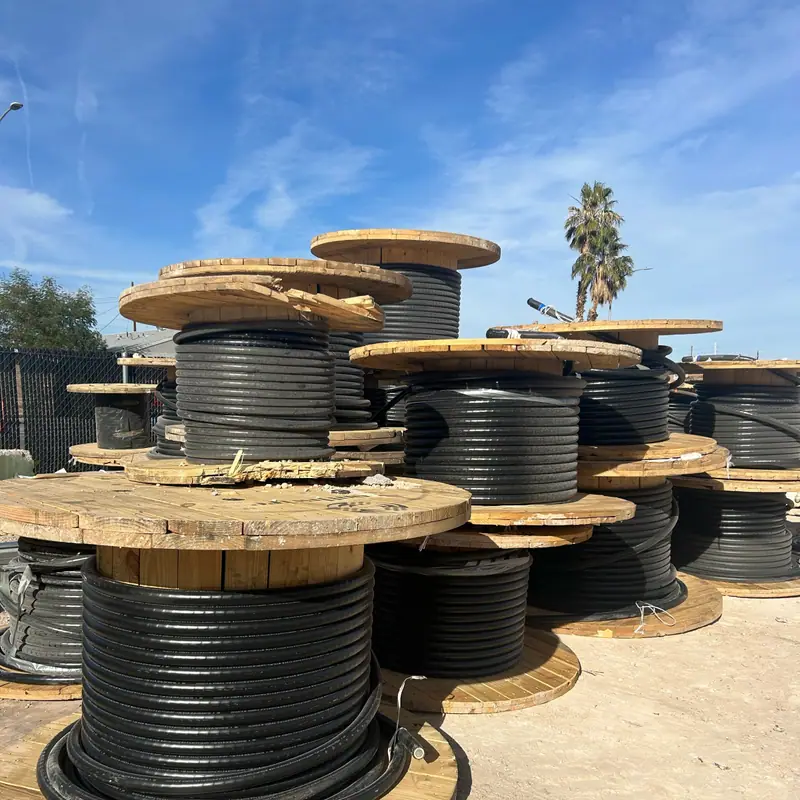
Freight Access and Reel Condition Before Texas Pickup
Describe where the reels sit: inside a warehouse, on a loading dock, on pavement, or on unpaved ground. Include gate clearance, overhead obstructions, dock availability, and any restrictions on vehicle access. Overall reel width matters for loading layout as much as flange diameter.
Keep reels stable and protected while pickup is being arranged. Photograph broken flanges, loose cable turns, projecting nails, water exposure, and damaged jacket areas without moving an unsafe reel. Our Texas reel storage guide covers practical ways to protect reusable material.
Reels need appropriate blocking and securement for transport; damaged packaging may require a different handling plan. Do not roll a heavy reel down a slope or attempt to catch one that starts moving.
Send Reel Details for a Written Surplus Wire Offer
We buy reusable wire and cable, not material priced as scrap: unused full and partial reels, boxed coils, cut lengths, overstock, project leftovers, and used cable still suitable for reuse. Reusable product is usually worth more sold as wire than sold only for its metal weight.
Send reel-tag, jacket-legend, cut-end, and whole-lot photos with a list or footage estimate through our offer request form, by phone at 951-403-5738, or by email at industrial832@gmail.com. We review the material and provide a written offer before pickup; payment method and timing are confirmed in writing before pickup.
We verify the seller and proof of ownership, such as an invoice, purchase order, closeout paperwork, or company letter; see our Texas seller paperwork guide. At pickup or receipt, we check the count against the written terms.
We arrange pickup anywhere in Texas, or you can call first to schedule drop-off at 6402 McGrew St, Houston, TX 77087, in southeast Houston near I-45 and Loop 610. If your wire is not reusable, we say so honestly; a scrap recycler may be the appropriate destination.